
SiFive 博客
来自 RISC-V 专家的最新洞察与深度技术解析

SiFive’s Approach to Embedding Intelligence Everywhere
Published by SemiWiki.
Before the advent of RISC-V, designers looking for embedded processors were effectively limited to a handful of proprietary processors using ISAs from decades ago. While the major ISAs are being updated and enhanced, they also are facing limitations from many decisions made over many years. RISC-V was conceived with a clean well-thought-out architecture and designed for expansion that would not create inconsistencies. Because it is open source, there is a rich set of tools and products that support it.
SiFive is one of the leading exponents of RISC-V and has been producing IP based on the RISC-V ISA for years now. Their product offerings have expanded significantly, now addressing everything from edge/IoT to server applications. Their recent webinar titled “Embedding Intelligence Everywhere with SiFive 7 Series Core IP” talks about how intelligence is needed in each market.
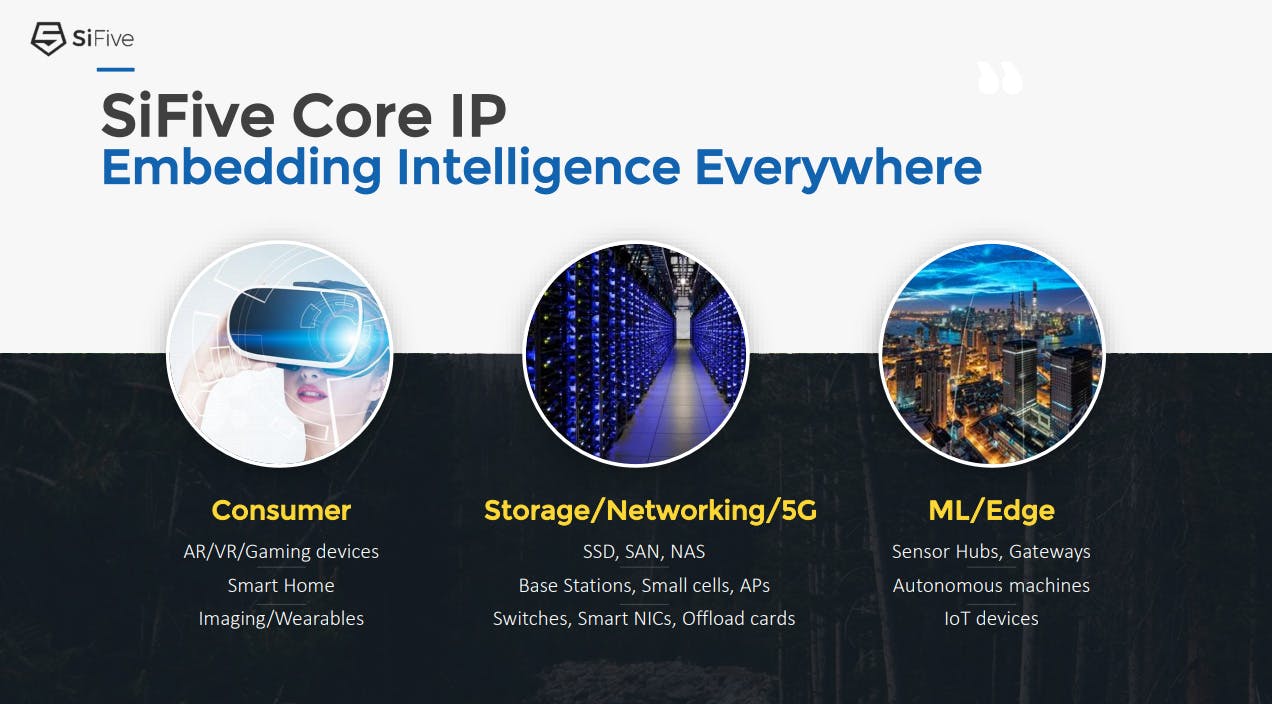
The webinar is divided into two parts. The first, presented by Jack Kang, Senior Vice President of Customer Experience at SiFive, offers a look at how embedded intelligence is becoming prevalent everywhere from the cloud to the edge. He also offers an overview of SiFive’s embedded RISC processors and how they fit current market needs.
Jack first talks about how AI is moving from the cloud to the edge, creating the need for additional processing capabilities in a wide range of devices. At the edge AR, VR and sensor fusion are driving the need for expanded real time processing. Jack also points out that there is also a need for increased intelligence in storage. He touches on how intelligence is supporting caching schemes, cryptography, memory maps and even in-cluster application processors. Likewise, making networking smarter facilitates higher bandwidth and other activities such as the implementation of 5G stacks.
The cores offered by SiFive are grouped by their application areas. The E Cores are suitable for 32-bit embedded uses. For heavier workloads there are the S Cores, which add 64 bit capabilities. The most powerful processors are the U Cores, which are 64-bit application processors for high-end computing.
Their smallest and most efficient RISC-V processor IP is the 2 Series, the E2 and S2, which are 32 and 64 bit respectively. They are core and memory configurable to customer specific needs. They also feature ultra-low latency interrupts for servicing real world events.
The 3 and 5 Series are their most widely deployed products. The E3 offers 32 bit performance for mid-range embedded applications. The S5 adds 64 bit and the U5 is the top end offering higher performance. These cores can be used in multicore configurations and have Hard Real Time capabilities.
The 7 Series cores are the topic of the later second section of the webinar. Jack touches on them before talking about the U8, an extremely scalable high performance out-of-order core with their highest performance per watt. The U8 is also very area efficient. The combination of area and power efficiency make them very attractive for high end computing systems.
The second section, presented by Jahoor Vohra, Director of Field Application Engineering, is titled “SiFive 7 Series Core IP”. His presentation discusses the features of the three members of the Core IP 7 Series: E7, S7 and U7. This includes an overview of the 7 Series microarchitecture, focusing on performance, scalability and the detailed specifications of each.
The 7 Series are scalable up to 8+1 for each cluster. Like other RISC-V processors the instruction set is extensible through custom instructions. Their memory is configurable and tightly integrated for low latency. If called for, they support mixed precision arithmetic. They also feature enhanced determinism to better support demanding real time applications. There are also functional safety features provided by built-in fault tolerance mechanisms. These are just a few of the highlights that Jahoor brings up.
To gain a full appreciation and understanding of the SiFive offerings, across the board and about the 7 Series in particular, I highly suggest viewing the informative webinar. I have been following RISC-V and SiFive for a number of years now. The level of adoption and progress has been extraordinary. The entire effort is supported by some brilliant dedicated minds. The results speak for themselves.
SiFive is also has a webinar on the topic of [Rapid Embedded Prototyping with SiFive Software] (https://www.sifive.com/resources/webinar/rapid-embedded-prototyping-with-sifive-software). These webinars are all part of the SiFive Connect webinar series, which aims to provide educational content in an interactive format. A full list of SiFive webinars can be found here.